
The Science of Steaks: Why Is Wagyu Beef So Expensive?

When you spot Wagyu on a high-end menu, the price tag stops you in your tracks. The reality on the ground is that this isn't just regular meat with a luxury markup. Authentic Wagyu requires years of specialized breeding, meticulously calculated feeding regimes, and obsessive traceability standards. Every phase of production works toward generating the insane marbling, velvety tenderness, and rich flavor profile that have turned this beef into a global culinary icon.
At ISU in St. Petersburg, Florida, guests frequently ask our culinary team what drives these premium prices. It ultimately boils down to pure genetics, extreme rarity, and the massive logistical labor required to raise cattle that fulfill authentic Japanese standards.
Key Takeaways
Genetic Predisposition: Authentic Wagyu cattle possess a unique biological ability to develop dense, fine intramuscular fat.
Extended Life Cycles: Farmers raise these animals up to three times longer than standard commercial beef cattle.
Obsessive Oversight: Independent Japanese grading boards track every animal from birth to plate via a strict 10-digit ID system.
Import Logistical Demands: Heavy tariffs, strict quotas, and cold-chain air freight inflate the final costs for domestic diners.
Unmatched Eating Profile: The high concentration of monounsaturated fatty acids causes the beef to melt at actual room temperature.
How Does Wagyu Differ From Traditional Beef?
The definitive difference between Wagyu and standard commercial beef centers entirely on the structural distribution of intramuscular fat, universally known as marbling. Conventional cattle develop thick outer caps of gristle, whereas Wagyu weaves a delicate, snowflake-like web of lipids directly through the muscle fibers. The result is an incredibly tender texture that dissolves on the tongue.
This structural anomaly isn't accidental; it requires absolute genetic purity. Standard domestic cattle simply lack the metabolic pathways to deposit fat in this manner without becoming unhealthy. When cooked, these micro-strands of fat liquefy from the inside out, basting the meat internally and yielding a decadent, buttery flavor profile that standard choice or prime steaks cannot replicate.
What Is the Secret Behind Wagyu Genetics?
The foundational reason behind the question, "why is wagyu beef so expensive?" rests on centuries of strictly controlled, isolated bloodlines. True Japanese Wagyu stems from four specific native breeds, with Tajima line cattle serving as the gold standard for high-density marbling.
Japanese authorities treat these herd genetics as a national treasure. Exporting live cattle or genetic material out of the country is strictly forbidden by law. To maintain herd integrity, breeders use complex software to map matings generations out, avoiding inbreeding while maximizing marbling potential and carcass yields. This microscopic level of population management keeps the global supply pool incredibly small, ensuring that authentic inventory remains highly exclusive.
Why Do These Cattle Require an Extended Lifespan?
Time is the ultimate driver of livestock overhead, and Wagyu cattle live significantly longer lives before processing than any other beef breed on earth. While a standard American steer goes to market after 120 to 180 days on a feedlot, authentic Wagyu is meticulously husbanded for 600 to 700 days, and frequently longer.
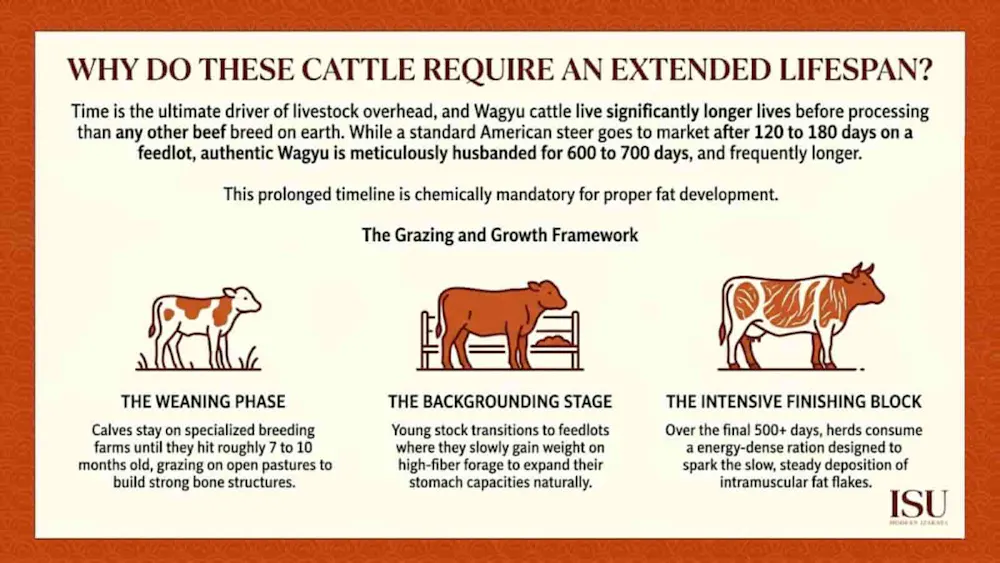
This prolonged timeline is chemically mandatory for proper fat development.
The Grazing and Growth Framework
The Weaning Phase: Calves stay on specialized breeding farms until they hit roughly 7 to 10 months old, grazing on open pastures to build strong bone structures.
The Backgrounding Stage: Young stock transitions to feedlots where they slowly gain weight on high-fiber forage to expand their stomach capacities naturally.
The Intensive Finishing Block: Over the final 500+ days, herds consume a energy-dense ration designed to spark the slow, steady deposition of intramuscular fat flakes.
How Do Specialized Rations Drive Production Costs?
Wagyu nutrition is an exacting science that relies on high-quality, expensive feed imports rather than cheap local silage. To ensure the fat develops with a low melting point, farmers feed their herds a proprietary mix of rice straw, whole corn, barley, and wheat bran.
Keeping a single animal on this premium, energy-dense regimen for over two years requires staggering capital. Rice straw alone is critical; it contains vitamins that help regulate the formation of pure white fat marbling. This rigorous commitment to clean nutrition is exactly why guests at ISU recognize the deep value behind the curated steak cuts we plate daily here in St. Petersburg, Florida.
How Does Culinary Preparation Honor This Premium Meat?
Experiencing why is wagyu beef so expensive becomes clear the moment a chef uses precise, high-heat techniques to sear the meat without rendering out its delicate fat. Specialized kitchens employ minimal seasoning—often just sea salt and flash-searing—to let the natural, nutty aroma of the melting lipids take center stage.
Local Menu Showcases
Wagyu Gyozas ($19): Dumplings packing rich, seasoned Wagyu meat, balanced beautifully with sweet plantain, corn silk, and a concentrated natural reduction.
Black Cod ($46): A pristine seafood alternative that brings together savory rocoto miso and bright salsa criolla to cut through rich coastal flavors.
Wagyu Ribeye ($90): A magnificent 14-ounce centerpiece cut brushed with umami-rich aji panca-koji and brightened with a pickled chili escabeche.
Why Do Boutique Japanese Operations Demand More Labor?
Unlike the massive corporate ranches found across the American West, Japanese Wagyu production thrives on small-scale, artisanal family farms. The majority of these operators raise fewer than 34 head of cattle simultaneously, allowing individual attention for every animal.
This hyper-focused approach means labor costs are undeniably high. Ranchers spend hours monitoring daily feed intake, adjusting barn temperatures, and building custom bedding to eliminate any stress that could trigger cortisol production—a hormone that ruins fat consistency. It is a lifetime commitment to a specialized craft passed down through generations, directly elevating the baseline cost of the livestock.
How Does Government Documentation Fight Counterfeiting?
The Japanese government enforces a mandatory, airtight tracking system that registers every calf with a unique 10-digit National ID number. This digital footprint maps the animal's entire lineage, birth date, exact farm location, feed history, and official grading metrics.
Authentic Sourcing Metrics
Individual Nose Prints: Farmers take unique physical prints at birth to verify identities and eliminate farm-gate fraud.
Lineage Verification: Every carcass traces back three full generations via DNA sampling to confirm genetic purity.
Public Database Access: Wholesalers and restaurateurs utilize open government portals to verify certificates before purchasing.
What Logistical Hurdles Affect Trans-Pacific Shipping?
Bringing fresh, authentic beef across the Pacific Ocean introduces complex international supply chains and steep regulatory fees. Because true Japanese Wagyu is never frozen to protect its delicate cellular walls, it must travel via highly monitored, climate-controlled air freight.
Importers must navigate strict USDA inspections, rigorous customs clearance protocols, and custom duties. Air transport rates vary wildly based on global fuel costs, and space in specialized refrigeration containers is always at a premium. By the time these pristine cuts arrive at high-end dining destinations across Florida, multiple layers of customs and transit expenses have naturally been built into the final invoice.
How Does Basic Economics Shape Global Pricing?
The ultimate price driver is basic market economics: an incredibly tight global supply wrestling with an exploding consumer demand. Japan only exports a small fraction of its total A5-graded yields each year, leaving international distributors fighting over limited allocations.
Luxury hospitality groups, cruise lines, and elite steakhouses constantly outbid one another to secure these rare allocations. Since expanding a herd requires a minimum three-year lead time from conception to plate, producers cannot scale up supply dynamically to cool down market prices. When luxury demand outpaces agricultural capacity, wholesale costs inevitably spike.
Evaluating the Investment: Is True Wagyu Worth It?
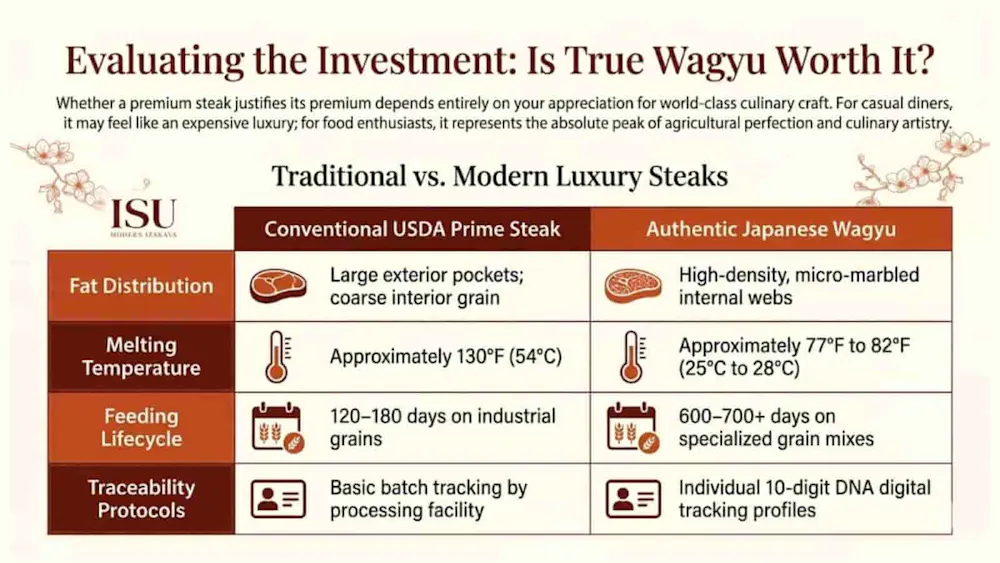
Whether a premium steak justifies its premium depends entirely on your appreciation for world-class culinary craft. For casual diners, it may feel like an expensive luxury; for food enthusiasts, it represents the absolute peak of agricultural perfection and culinary artistry.
Traditional vs. Modern Luxury Steaks
Evaluation Metric | Conventional USDA Prime Steak | Authentic Japanese Wagyu |
Fat Distribution | Large exterior pockets; coarse interior grain | High-density, micro-marbled internal webs |
Melting Temperature | Approximately 130°F (54°C) | Approximately 77°F to 82°F (25°C to 28°C) |
Feeding Lifecycle | 120–180 days on industrial grains | 600–700+ days on specialized grain mixes |
Traceability Protocols | Basic batch tracking by processing facility | Individual 10-digit DNA digital tracking profiles |
Understanding local definitions and grading standards
A5 Grading Scale: The highest possible score awarded by the Japanese Meat Grading Association, measuring yield ratios and extreme marbling scores.
Beef Marbling Score (BMS): A technical 1 to 12 rating system tracking the exact volume and distribution of intramuscular fat flakes.
Tajima Bloodline: The ultra-pure genetic lineage of black cattle native to Hyogo Prefecture, famous for producing legendary Kobe beef.
Intramuscular Lipids: The scientific designation for fat cells deposited inside muscle tissue fibers rather than on the outer edges.
A Chef’s Note on Marble Scores
The real secret behind the rich texture of high-grade Wagyu lies in its high concentration of oleic acid. This healthy, monounsaturated fatty acid drops the fat melting point significantly lower than human body temperature. When you place a slice of our seared ribeye on your tongue, the fat liquefies instantly, coating your palate and releasing an intense blast of umami flavor that leaves standard steaks far behind.
Elevating Your Dining Framework in St. Petersburg, Florida
Tasting this world-class beef firsthand is the only true way to understand the vast differences in texture and rich flavor profiles. At ISU, our culinary team treats every cut with maximum respect, utilizing precise preparation methods that allow the natural marbling to shine.
From delicate hot appetizers to a magnificent steak experience, we provide our St. Petersburg community a direct window into fine Japanese culinary tradition.
Elevate Your Culinary Perspective Tonight
The complex production loop behind this legendary beef—from guarded ancestral genetics and 700-day feeding structures to custom trans-Pacific logistics—explains exactly why is wagyu beef so expensive? It is an unparalleled culinary experience driven by generational craft and pristine quality standards.
Ready to explore these incredible flavor profiles for yourself right here in Florida? Call (727) 866-4633 to reserve your table today and taste the absolute pinnacle of premium steak preparation.
Frequently Asked Questions
Q: What does the word Wagyu actually mean?
A: The literal translation of Wagyu is "Japanese cow" ("Wa" meaning Japanese, and "gyu" meaning cow). It specifically identifies four native breeds developed and raised under Japan's rigorous agricultural guidelines.
Q: Why does Wagyu exhibit more intense marbling than regular steaks?
A: Wagyu cattle possess a distinct genetic blueprint that naturally deposits fat inside the muscle structure instead of creating an outer layer. Combined with a specialized grain diet spanning two years, this genetic trait creates their signature snowflake patterns.
Q: Is all certified Wagyu imported directly from Japan?
A: No, ranching groups raise crossbred and full-blood Wagyu in nations like Australia and the United States. However, authentic A5 Wagyu must be born, raised, and harvested in Japan under strict government observation to earn its official designation.
Q: Exactly how long are these premium cattle raised on farms?
A: Authentic herds are raised for 600 to 700 days, and sometimes longer, before harvesting. This extensive timeframe is nearly triple the lifespan of conventional commercial market cattle.
Q: Does authentic Wagyu taste different than traditional beef?
A: Yes, it delivers a distinctly rich, buttery flavor and tender mouthfeel that feels vastly different from standard steaks. The high concentration of oleic acid causes the fat to melt instantly on your tongue.